Box Math
Wildberger's Box Arithmetic
Norman Wildberger proposes a leaner foundation for mathematics — one in which every object is genuinely finite, directly constructible, and immediately encodable on a computer:
"We would like to propose a leaner foundation, called Box Arithmetic, in which every object is genuinely finite, directly constructible, and immediately encodable on a computer. The primary data structure is not a set but a multiset — which we call a box — where repetition is allowed and order is unimportant. Starting from a single object, the empty box (which we call zero), every mathematical object in our framework is built by finite nesting."
This is a serious proposal. It addresses the core complaint against standard foundations — that real numbers, infinite sets, and limit processes are not directly computable — and replaces them with a structure that maps cleanly onto what a computer actually does: finite nesting of finite objects.
The notation maps directly to the void algebra:
| Box Arithmetic | MMP |
|---|---|
| empty box = zero | null void |
| nested box = one | |
| multiset (repetition allowed) | box with multiplicity |
The MMP Rebasing
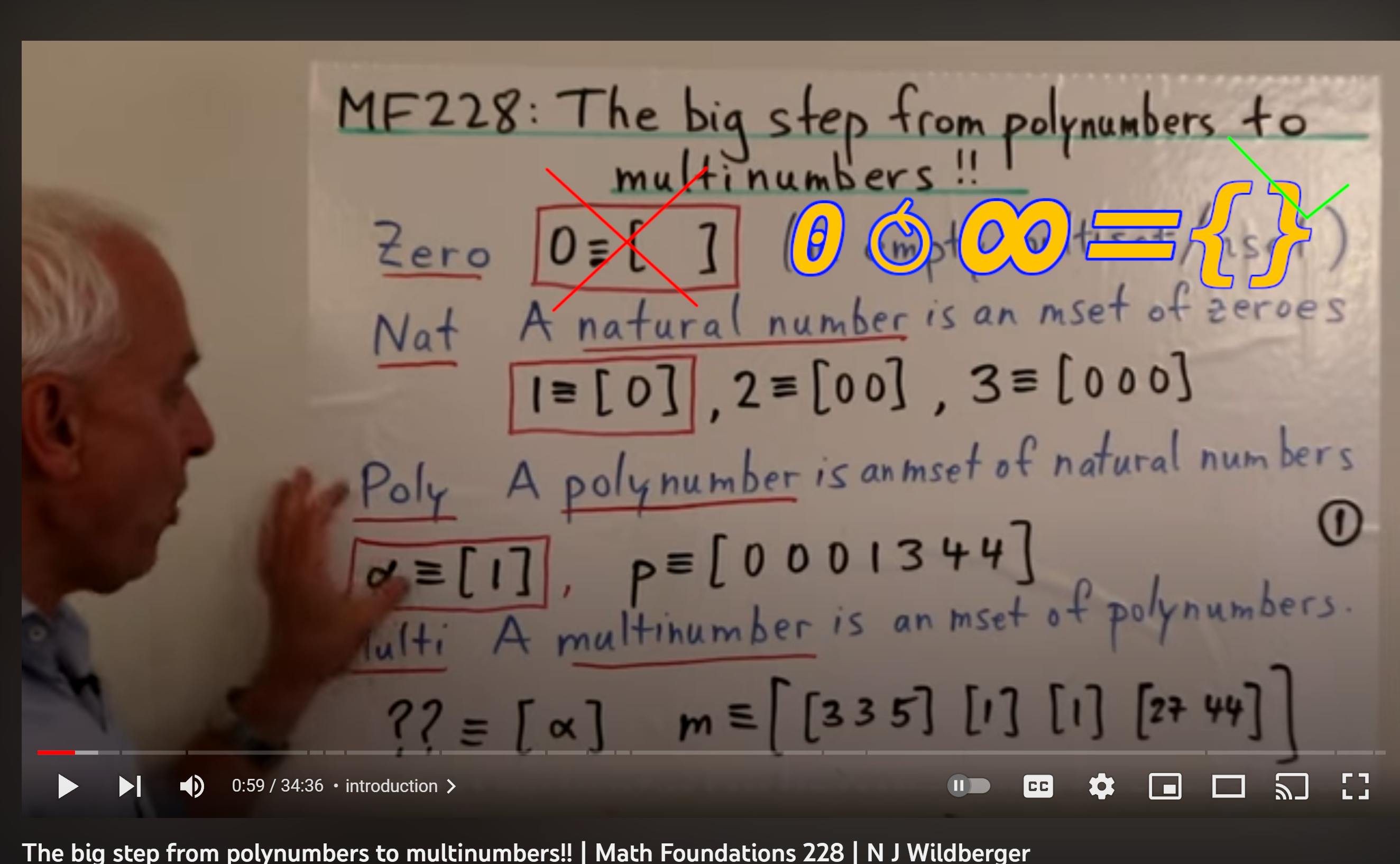
Wildberger's construction starts from the empty box as the primordial object — zero is given, and everything is built by nesting from there. This is clean, finite, and computable. MMP accepts all of that.
The single departure: the empty box is not primordial. It is derived.
The empty box — null — is what you get when the positive void and negative void cancel under addition. It is the result of orientation erasure, not a first principle. To begin from without asking where it came from is to start from a result and call it a foundation.
MMP asks: if zero is the empty box, where does the empty box come from? The answer — it comes from the cancellation of the two oriented poles, which themselves arise from the infinite nothingness — is what the rest of this section has been building toward. The box arithmetic Wildberger describes is the correct computational machinery. MMP simply provides the prior chapter: the one that explains why the empty box exists and what it means.
From the infinite nothingness, through the ouroboros operator, to the empty box, to finite nesting — the full arc is:
Numbers as Knots of Nothingness
In box arithmetic, is encoded as three copies of the empty box held in one box — a multiset, where repetition is allowed and order is unimportant:
This is correct and computable. But MMP suggests a different reading of what that structure is. Each empty box is not "one more zero added" — it is one more fold of the infinite nothingness. is not a pile of three zeroes. It is the infinite nothingness, knotted.
The analogy is the trefoil knot — the simplest non-trivial knot, a single continuous strand that crosses itself exactly three times to produce a closed, self-consistent object. The crossings are not separate things; they are the same strand in relationship with itself. Counting the crossings gives you the number, but the number is the knot — a topological fact about how nothingness has been folded.

This reframes what integers mean in MMP: not a count of empty boxes assembled from a zero that was given, but a topological invariant of a self-knotted void. The empty box is still the unit. But the unit is not flat — it is a fold, and the number is the depth of the folding. See Knot Theory for the full extension.
Box Arithmetic Operations
The four fundamental operations on boxes follow directly from the multiset structure:
Addition (box union with multiplicity) — merge the contents of two boxes into one:
Note that — repetition is preserved, not collapsed. This is distinct from algebraic simplification.
Multiplication (Cauchy / caret product) — form all pairwise products of elements:
For polynumbers (boxes of naturals), this is the standard Cauchy convolution of coefficient arrays. For general boxes it is the Cartesian product.
The caret A ^ B generalises this to a box-valued outer product, and is the engine behind the Finite Ideal Approximation exercises in Box Math & Primes to 11:
Evaluation — substitute a box in place of the variable in a polynumber , then apply multiplication. Element evaluation distributes elementwise: .
These operations are implemented in the boxmath TypeScript package and the BoxMath.sol Solidity contract. See the BoxMath SDK for code examples, the fixed-point encoding, and how each operation maps to the classes in the library.