The Mystical Metaphysical Number System
As analysis dispensed the geometers, and the Renaissance minds laid content on the limits described by Galois on polynomials, the notion of the axioms — the linchpins of mathematics — departed from the physical sensibilities of the compass and square, and were watered down to paper over incommensurate nuances. Perhaps the departure would've remained permanent, if those hadn't found the transistor so conducive to boolean logic. But alas, rounding errors are exploited for major sums of money, a good deal of music is needlessly out of tune, and grand mathematical traditions, such as the quadrature of the circle, are dispensed as 'solved' to great calamity for a lack of appreciation of the distinction between precision at iteration and exactness.
Rounding errors are made explicit by those geometric attempts to rescue a number, overtone locking for ringing chords isn't possible in 12-TET to the same degree as the limit tuning, and again one has reason to become infatuated with the cosmic proportionality of the pyramid, from its reflection in the scale of the moon and earth, to the hydrogen fine spectrum's alpha 137.5 volume relation in the King's Chamber — a unification of the cosmos resting atop Kepler's triangle.
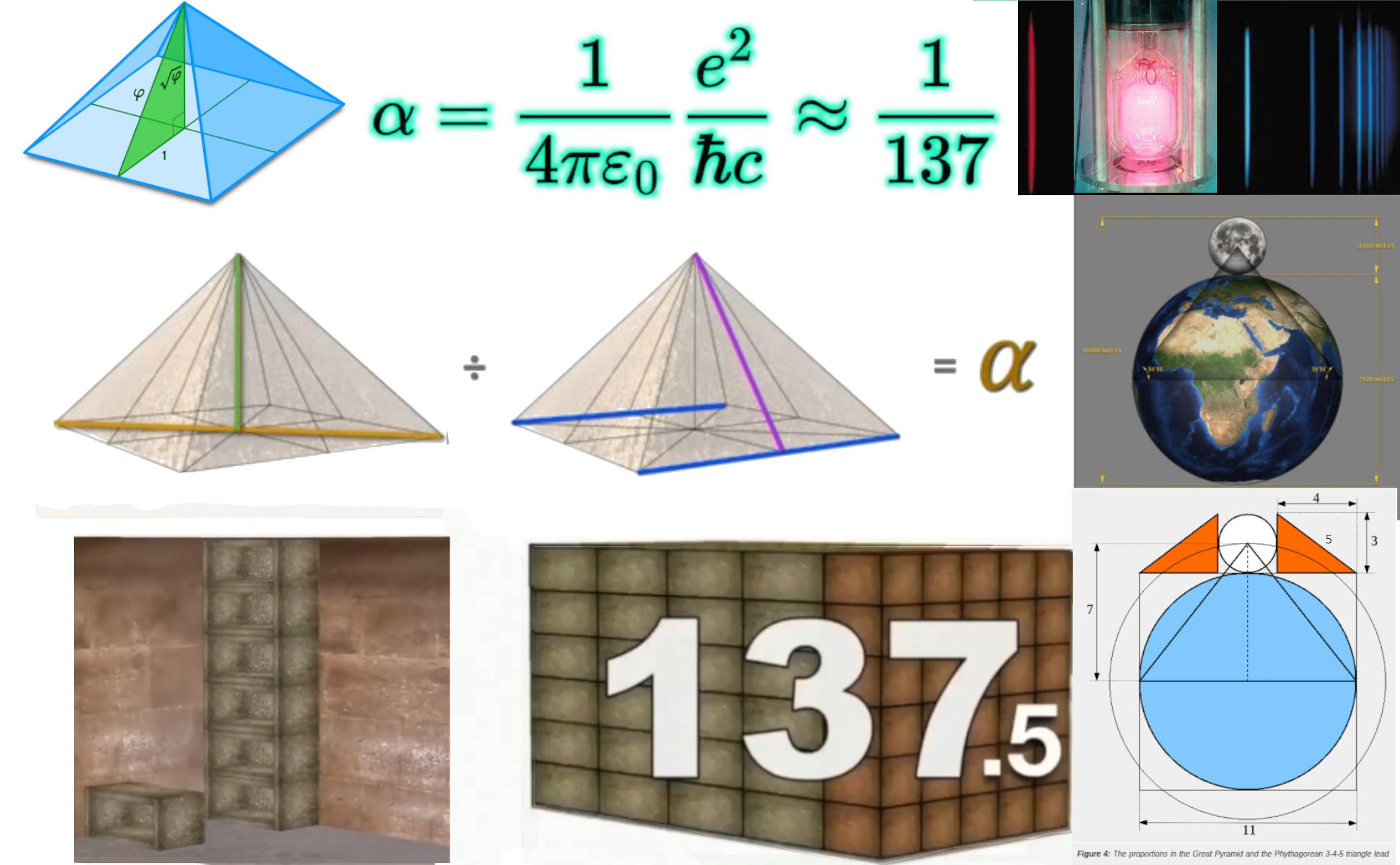
Source: Great Pyramid encodes physics' most mysterious number Source: phi in the great pyramid
A user naively basking in the dominion of the real number system expects subconsciously from the computer the world of decimation at the touch of the sqrt(2) button on their calculator. The geometer is lucky to discern just one degree of precision from their lines drawn perpendicularly in the sand. The computer then rests in the unfortunate chasm in between — demanding geometric resolution on the hardware level while trying to provide the illusion of the real number system in user space.
Source: Square root of two is not a number
Thus it is a good time to note that MMP is neither a finitist nor an infinitist philosophy, nor a purported third position. It is a Rosetta stone, a keystone between two mathematical canons which have withstood the sands of time and reached the orbits of the moon. It is the unfortunate circumstance that the majority of readers herein come almost exclusively from the real number canon — thus may demand additional justification and explanation toward what finitists would find immediately apparent. Neither approach is promoted at the other's expense; rather MMP meticulously clarifies the distinction and domain between the two through its model.
"My contemporaries and I were taught that in order to design a complete and exact sphere and have no materials left over, we must employ the constant known as pi (pi)"... and I asked, "To how many places does nature carry out pi when she makes each successive bubble in the white-cresting surf of each successive wave before nature finds out that pi can never be resolved?" . . .
— Buckminster Fuller, Synergetics 986.088
MMP begins by asking what the nothingness actually represents. One may immediately reach for their conception of zero — an absence of something, a placeholder. They may be content with the phrase "I have zero things"; however, the philosopher and logician would attest to the inconsistency: one has a something to describe a nothing. You can't hold zero things, so can we assign units to 0? Absolute zero in physics still contains a degree of freedom — that half quantum of energy. If no system can be without positive energy, then a statement of zero joules must be in the context of an equality, which can be represented without zero (, or ). One may then reason that, while the nothingness and zero are useful concepts in their own domains, this implicit equality of the two doesn't actually hold water.
MMP continues from another direction: what is the infinite? One may immediately reach for their conception of infinity — something immeasurably large, long, or heavy. In many instances, such as the magnetic field around a wire, such reasoning helps in understanding nature. However the logician again points out the inconsistency. While one may conceptualise the object, they would ask: where is it? One could provide a start but no end. Indeed, when pondering the matter, if Waldo were infinitely long, you'd have no trouble finding where he begins, but you could never confirm or prove that's where Waldo is — you might see his shoes, but the final confirmation, the tip of his hat, you'll never see. So this idea that infinity can be placed on the number line, as if it has a beginning and an end somewhere far away, is also unreasonable. From here one begins to feel the contrasting nature of the nothingness and the infinite.
One may reason that these ideas are opposing orientations on the same axis. Zero has endless precision and no length; infinity has endless length and no precision — neither belongs on any number line by itself. MMP then, in its determination to fracture modernity's dominant notion of the continuum, is obliged to replace it with something it finds more tenable. Perhaps a continuum can be modelled from a sort of congealing of these poles, a balancing of opposites — a quaternary — so that one's reasoning about the nothingness and the infinite remains congruent between logic and mathematics. MMP defines the infinite nothingness — oriented voids that donut in and out of themselves — as the fundamental element of Box Arithmetic: a leaner foundation than polynomials that is directly encodable on a computer. It accomplishes this through the ouroboros operators and :
And from there we can derive the fundemental identity of MMP
From this, the paradoxical identity is not a convention inherited from combinatorics or a simplifying assumption that keeps power series tidy. It derives from the idea that these zeros, whatever they may be, carry a stress energy vibrating inside themselves yet balanced to the outside. The statement is not quieting or serenity, but an equal tension of opposing forces. MMP draws a sharp distinction between and — the former loses the aspect of stress energy; the latter dispenses with paradoxical motions and reveals the balance.
When viewing the identity geometrically, we note as a dimension-hopping construction. A square is , a cube — going from cube to square is 3 to 2, square to line is 2 to 1, line to point is 1 to 0. Then what of zero to zero? Geometrically, is trying to climb a dimension up from the zeroth dimension of no length. What is this idea of climbing from the netherspace — this void, this dimension zero — into the physical realm? MMP's fundamental identity illustrates it quite clearly: oriented voids knot through each other, composing unity within the continuum. Infinity's length is balanced by nothingness's precision and vice versa.
Whether this recovers something the Egyptian priests understood and the Greeks only partially received, or simply discovers something new by looking in an old direction — the pyramid was built to last; perhaps it was also built to be read — we cannot say with certainty. What we can say is that the algebra is simple, the results are sharp, and the questions it opens are worth asking.
Number
Length & precision, physical & metaphysical, mystical numbers, the resolution (oriented voids and the ouroboros operator), the smoking gun (), holographic unity, box math.
- Length & Precision · Physical · Metaphysical · Physicalization
- Mystical Numbers · The Resolution · Zero Powers of Zero
- Holographic Unity · Box Math
ArchaeoArithmetic
Ancient maths through an MMP lens — Egyptian number systems, π/φ/powers-of-2 coincidences, the cubit, the Great Pyramid, 11-odd-limit, precession and the Great Year.
- Egyptian Maths · Mathematical Coincidences · The Cubit
- The Great Pyramid · Box Math & Primes to 11 · Precession & the Great Year
Applications
The why of rerouting box math — bridging pure and applied, precision vs exactness, harmonic proportions, music, smart contracts, ontological completeness, memristors, balanced ternary, Bell's inequality.