Length & Precision
Every number has two fundamental properties:
- Length (N) — the number of digits required to perfectly describe the number
- Precision (dN) — the displacement along the numberline per stepwise digit;
d/dN
Iterative Resolution
All numerical quantities resolve their precision iteratively with length. Consider the number 12345 — we arrive at the true value one digit at a time:
| Step | Value | Displacement remaining |
|---|---|---|
| 1 | 1 | large |
| 2 | 12 | smaller |
| 3 | 123 | smaller |
| 4 | 1234 | smaller |
| 5 | 12345 | zero |
Each digit added reduces our displacement on the numberline. Precision is the rate at which that displacement shrinks per unit of length. A finite number reaches zero displacement in finite steps. A transcendental number never does — it keeps demanding more length, and its precision is always nonzero, always retreating.
This is the MMP framing of what Cauchy sequences describe analytically: the terms of a sequence are within of the limit, find so that . In MMP language, the sequence is walking down the digits and the limit is the number it is trying to describe.
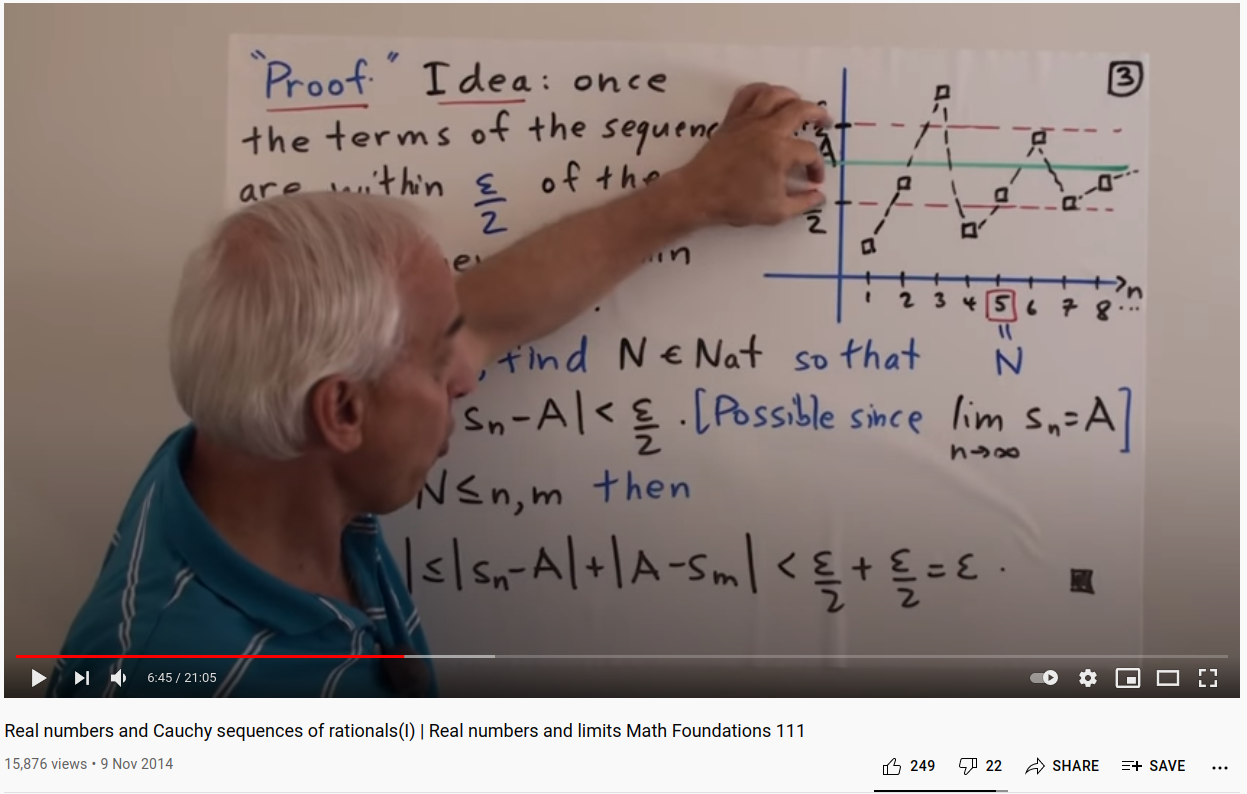
Norman Wildberger on Cauchy sequences of rationals — Real numbers and limits Math Foundations 111
The Golden Ratio — Resolution of the Most Irrational Number
The Fibonacci sequence resolves — the golden ratio, the universe's most irrational number — iteratively:
Each successive ratio of consecutive Fibonacci terms is a better approximation — the displacement from decreases with each step, length increases, precision tightens. The golden ratio is the slowest converging continued fraction precisely because it is maximally irrational: it demands the most length for the least precision gain per step.
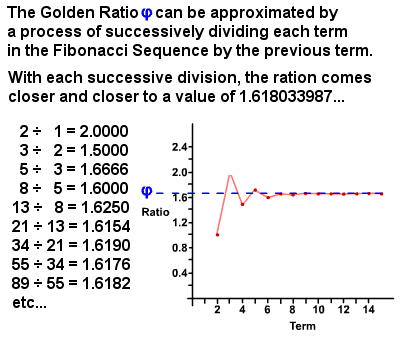
In MMP terms, is a number with infinite length and perpetually nonzero precision — yet the Fibonacci sequence demonstrates nature resolving it iteratively, digit by digit, ratio by ratio.
The Circle Paradox
Here is a motivating hint at the deeper problem. We approximate a circle by increasing the number of vertices of a polygon — more sides, closer to the curve, precision tightens with each step. By MMP's framing this is a metaphysical number in progress: is being approached iteratively, length growing, displacement shrinking.
But consider the limit. A circle has no sides. The polygon with infinite vertices is not a circle — it is a metaphysical thing pretending to be one. The circle itself sits outside the iterative process entirely, belonging to a class of object the process can approach but never become. The question of whether a smooth curve is the limit of a jagged one, or something categorically different, is precisely the question MMP asks of all transcendental quantities.
Three Classes of Number
MMP observes that all numbers fall into exactly three situations with respect to length and precision:
| Class | Relationship | Description |
|---|---|---|
| Physical | Precision reaches zero at finite length | Perfect description in finite digits — displacement closes |
| Metaphysical | Length and precision directly proportional | Adding digits never closes the displacement; , , live here |
| Mystical | Length and precision inversely proportional | Adding magnitude reduces precision — the boundary paradox at zero and infinity |
Physical numbers are those the numberline can hold exactly. Metaphysical numbers demand infinite length — nature can approach them iteratively but never land. Mystical numbers are the poles themselves: zero, with infinite precision and no length, and infinity, with infinite length and no precision. In the mystical case, length and precision trade off completely — each step toward one is a step away from the other.